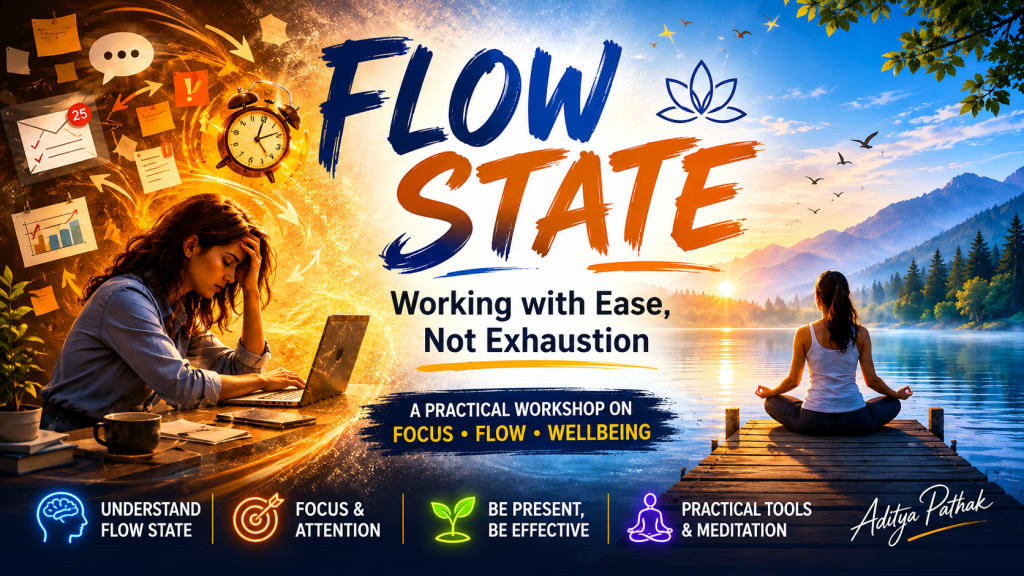
Many of us spend a significant part of our lives working, creating, solving problems, and pursuing goals. Yet, despite all our efforts to become more productive, we often find ourselves exhausted, distracted, and disconnected from the very work we care about.
Over the years, I’ve become increasingly interested in a simple question:
Why do some moments of work feel deeply fulfilling and energizing, while others leave us drained?
The concept of Flow State offers an intriguing answer.
Flow is a state of deep engagement where attention is fully absorbed in the task at hand. Time seems to pass differently. Distractions fade into the background. There is effort, but not struggle. Challenge, but not overwhelm.
Athletes experience it during peak performance. Musicians encounter it while performing. Artists, writers, programmers, teachers, leaders, and craftspeople often describe similar moments when they become completely immersed in what they are doing.
In these moments, work feels less like a burden and more like a natural expression of our abilities.
Beyond Productivity
Flow is often discussed as a productivity tool, but I believe it is much more than that.
At its heart, flow represents a meeting point between effectiveness and wellbeing.
When we are present, focused, and connected to a meaningful challenge, we not only perform better—we often feel more alive.
This perspective is particularly relevant in a world filled with constant notifications, fragmented attention, information overload, and increasing demands on our time and energy.
Rather than asking, “How can I do more?”, flow invites us to ask:
“How can I bring my full attention to what matters most?”
What Creates Flow?
Research and lived experience suggest that flow emerges when several conditions come together:
- Clear goals and direction
- A balance between challenge and skill
- Deep concentration
- Immediate feedback
- Reduced distractions
- Intrinsic motivation and meaning
While we cannot force ourselves into flow, we can intentionally create conditions that make it more likely to arise.
Flow and Mindfulness
One of the themes explored in this workshop is the relationship between flow and mindfulness.
Mindfulness trains our ability to notice where our attention is and gently bring it back to the present moment.
Flow represents what can happen when that attention becomes fully absorbed in a meaningful activity.
In this sense, mindfulness and flow are close companions. One cultivates awareness; the other often emerges from it.
Watch the Workshop
In the workshop below, I explore:
- What Flow State is
- Common barriers to deep focus
- The role of attention and presence
- Practical techniques for cultivating flow
- Simple mindfulness practices that support focused work
I hope the ideas shared in this session encourage you to reflect on your own relationship with work, creativity, and attention.
Perhaps the goal is not to constantly push harder, but to discover those conditions in which our best work naturally emerges.
I’d love to hear your experiences.
When do you feel most “in flow” in your work, creative practice, or everyday life?
— Aditya Pathak


Leave a Reply